IELTS Coaching in Jalandhar

About the Author & AptiGuide

Priyanka holds a Gold Medal in MA English (Language & Linguistics) and has been mentoring IELTS candidates for over a decade, guiding students appearing at British Council and IDP test centres across Punjab. Her structured verbal system is built around IELTS band descriptors — not generic English improvement.

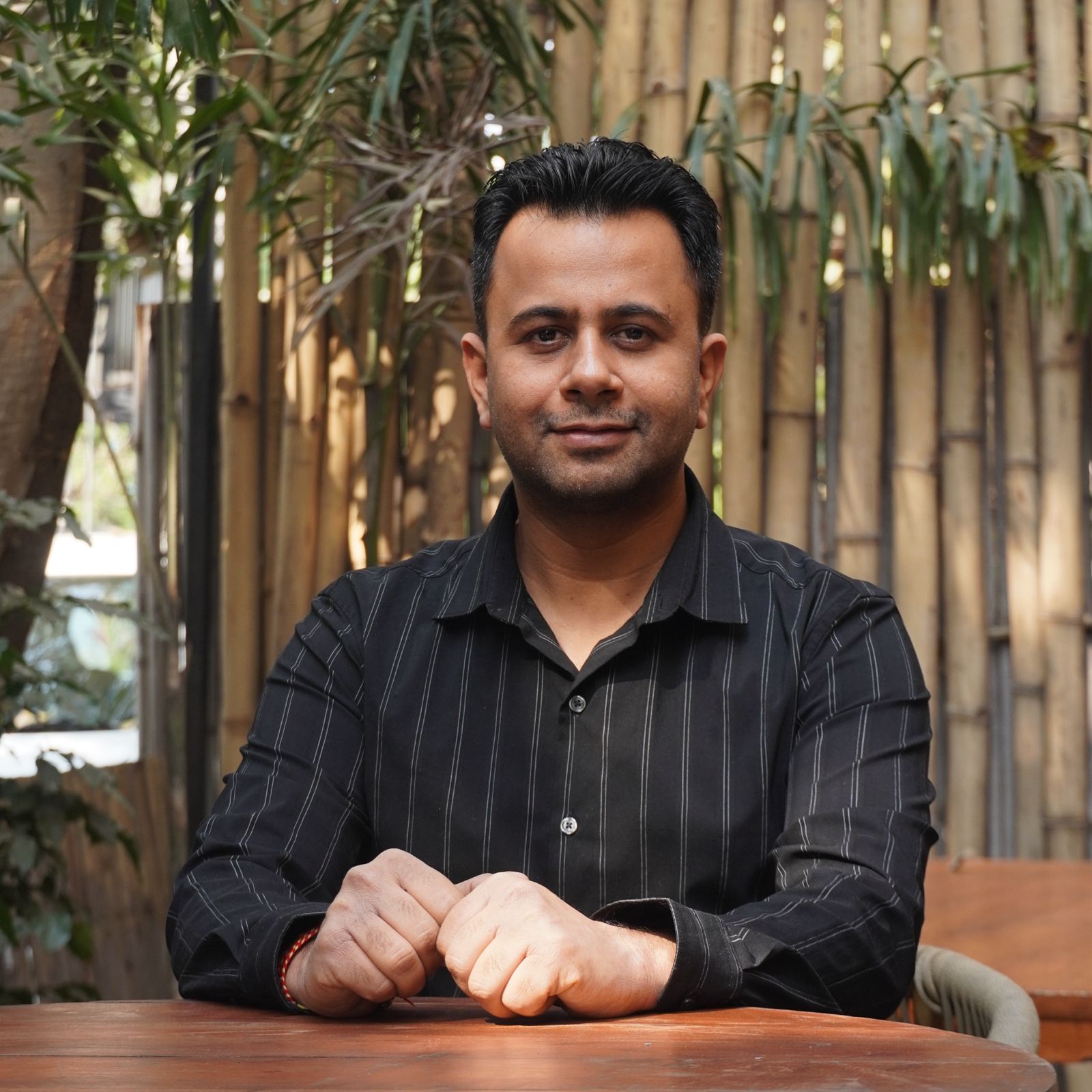
AptiGuide was founded in Jalandhar in 2018 by Anshul, a 10-time 99+ CAT percentiler with a career in structured academic mentoring. Every IELTS programme at AptiGuide runs under direct founder oversight with rubric-mapped feedback at its core.

This guide is written from 10+ years of classroom experience with IELTS students in Jalandhar and Punjab — not from generic internet research. All student outcomes cited are from actual AptiGuide batches.

Most IELTS Students in Punjab Are Making the Same Mistake

They assume that because they speak English reasonably well, the exam will follow. It won’t. IELTS is not a general English test. It tests whether you can perform four specific skills — Listening, Reading, Writing, and Speaking — under timed, structured conditions, according to precise band descriptors that most students have never read.

After working with hundreds of IELTS students in Jalandhar over the past decade, I can say with confidence: the students who plateau at 6–6.5 bands are not weak in English. They are weak in exam strategy — and nobody tells them that until it is too late.

What Is IELTS and Why It Matters for Students from Punjab

IELTS (International English Language Testing System) is jointly administered by the British Council, IDP, and Cambridge Assessment English. It is the primary English proficiency requirement for study abroad, PR, and immigration — particularly for Canada, Australia, UK, and Germany, which are the top destinations for students from Jalandhar and across Punjab.


Section

Duration

Format

What Is Actually Tested

Listening

30 min

4 recordings, 40 questions

Attention to detail, inference, note accuracy

Reading

60 min

3 long passages, 40 questions

Skimming speed, inference, comprehension under time pressure

Writing

60 min

Task 1 (150 words) + Task 2 (250 words)

Task achievement, coherence, lexical range, grammatical range

Speaking

11–14 min

3-part live examiner interview

Fluency, pronunciation, lexical resource, grammatical accuracy

Each section is scored on a 0–9 band scale. Your overall band score is the average of all four, rounded to the nearest 0.5.

Why Your Target Band Score Matters More Than You Think

Many families in Punjab set 6.0 as the default target because “visa lag jayega.” That thinking leaves significant opportunity on the table. Here is what the band scores actually unlock:


Band

What It Opens

6.0

Limited university options. Most top-100 global universities require 6.5+. Basic PR eligibility.

6.5

Mid-tier universities in Canada, UK, Australia. Many competitive programmes still closed.

7.0

Good universities across Canada, UK, Australia open. Most PR streams qualify at this level.

7.5+

Top-ranked programmes, scholarship eligibility improves. Strongest PR profiles. Some nursing/medicine pathways require this.

A half-band difference — from 6.5 to 7.0 — is the difference between a mid-tier placement and a genuinely good university. Given the investment families in Punjab make in study abroad, the return on structured IELTS coaching is significant.


Why Most Students Get Stuck at 6–6.5 Bands

These are the four failure patterns I see most consistently, with what the IELTS band descriptors actually say about each.

1. Writing Without Understanding the Scoring Rubric
IELTS Writing Task 2 is marked on four equally-weighted criteria: Task Achievement (25%), Coherence & Cohesion (25%), Lexical Resource (25%), and Grammatical Range & Accuracy (25%). Most students focus entirely on grammar and ignore coherence — which is where the 6→7 jump actually happens.
Band 7 Coherence & Cohesion requires: logical organisation with clear central topics in each paragraph, a variety of cohesive devices used flexibly, and clear referencing throughout. A well-structured essay with a clear position, PEEL-format paragraphs, and proper discourse markers will consistently outscore a grammatically perfect but loosely organised essay.

2. Memorising Speaking Answers
IELTS examiners are specifically trained to detect scripted responses. The Band 7 Fluency & Coherence descriptor requires “extended discourse with only occasional repetition or self-correction” and explicitly allows “some hesitation.” Memorised answers produce flat, unnatural delivery that scores poorly on Fluency regardless of grammatical accuracy.
The fix is not to memorise less — it is to train topic expansion and self-correction as live skills, not scripted performance.

3. Reading Too Slowly or Too Carefully
The Reading section has 40 questions across three increasingly complex passages in 60 minutes — roughly 90 seconds per question, including time to locate the answer. Students who read linearly, word by word, run out of time before they run out of comprehension.
Effective IELTS Reading is a location skill before it is a comprehension skill. Skim for structure, scan for keywords, then read the relevant section closely. This is a trainable skill, not a talent.

4. Preparing Without Structured Feedback
This is the biggest gap. Without someone identifying your specific error patterns — habitual filler sounds in Speaking, weak paragraph openers in Writing, failure to use parallel structures in complex sentences — you practice the same mistakes more fluently. You get faster at being stuck.

Verified Student Outcomes — AptiGuide, Jalandhar

These are real students from our batches, shared with their permission. The specifics demonstrate the link between the coaching intervention and the result — not just the final band score.

Harpreet S. — Commerce Graduate, Jalandhar (2024)

Starting band: 6.0. Weak area: Writing Task 2. Her essays had strong ideas and reasonable grammar but no clear paragraph structure. Paragraphs opened with vague topic sentences; discourse markers were absent. Intervention: 6 weeks of PEEL structure training, discourse marker drills, and weekly rubric-mapped essay feedback targeting Coherence & Cohesion.

Result: 7.5 Overall | Writing: 7.0 | Listening: 8.0


Simrandeep K. — Working Professional, Phagwara (2025)

Target: Canada PR (required 7.0 CLB). Stuck at 6.5 Speaking across two attempts despite strong conversational English. Root cause: memorised answers producing flat delivery, flagged by examiner for rehearsed quality. Intervention: Topic-based conversation practice with real-time feedback on self-correction and topic extension techniques.

Result: 7.0 Speaking | 7.0 Overall — Canada PR application submitted


Gurpreet M. — 12th Pass, Jalandhar (2024)

Strong comprehension but consistent time management failure in Reading — leaving 6–8 questions unanswered per full test. Intervention: Systematic skimming and scanning drills with strict timed practice (90 sec/question target), plus question-type mapping for True/False/Not Given, Match Headings, and Sentence Completion formats.

Result: Band 7.0 Reading | 6.5 Overall (improved from 5.5 overall)

How AptiGuide Approaches IELTS Coaching Differently

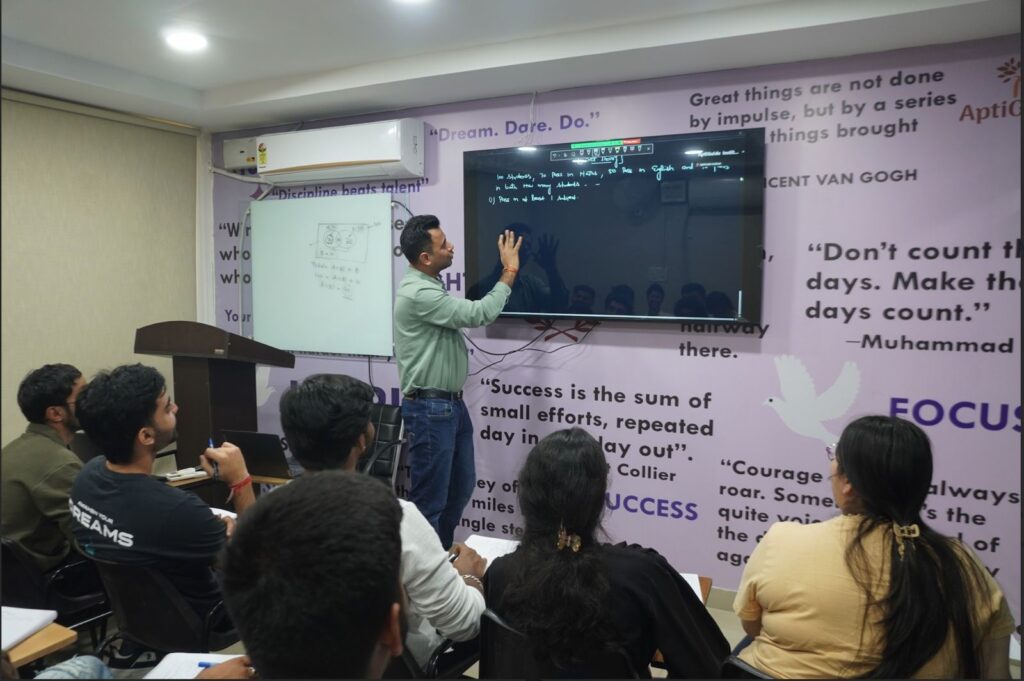
Most IELTS coaching in Jalandhar gives you practice material and a timetable. We give you a feedback system built directly around IELTS band descriptors.

Step 1: Diagnostic Test
Before any coaching begins, we run a full-length timed test under exam conditions. This produces your actual section-level starting scores — not self-reported estimates. It takes approximately 3 hours and is the foundation of your entire preparation plan.


Step 2: Skill + Strategy Training by Section
• Writing: PEEL structure for Task 2; data description frameworks for Task 1 (bar chart, line graph, process diagram, map); discourse marker training mapped to Band 7 Coherence descriptors
• Speaking: Topic expansion techniques (PREP framework); self-correction drills; pronunciation coaching for intelligibility, not accent elimination
• Reading: Skimming and scanning drills timed to 90 seconds per question; question-type-specific strategies for True/False/Not Given, Match Headings, and Sentence Completion
• Listening: Section-specific focus drills — Form Completion, Multiple Choice, Map Labelling, and Note Completion each require different listening strategies

Step 3: Weekly Written Feedback on All Written Submissions
Every Writing Task 1 and Task 2 receives a rubric-mapped evaluation: a specific breakdown of which criterion (Task Achievement, Coherence, Lexical Resource, Grammatical Range) cost marks and exactly how to fix it. This is the core of what separates structured coaching from self-study.


Step 4: Full-Length Mock Tests with Performance Tracking
Full-length timed mocks are run at intervals throughout the course. Band scores are tracked by section over time, not just at the end. This identifies improvement trends and addresses plateaus before they become exam-day problems.

We map your target band to your actual university shortlist or PR pathway — not a generic number. If your programme requires 6.5, you do not need to chase 7.5. If your Writing is at 6.0 but your target requires 7.0, we know exactly what to prioritise. This focus makes preparation efficient.

Course Structure

Detail

Specifics

Duration

4–8 weeks, determined by diagnostic baseline score

Mode

Offline (Jalandhar centre) + Hybrid option available

Batch Size

Small batches — personalised written feedback possible for every student

Daily Practice

Timed drills for each section, assigned daily

Feedback Frequency

Weekly written evaluation per student, rubric-mapped to band descriptors

Mock Tests

Full-length timed tests with section-level band scores tracked over time

Study Abroad Link

Band target mapped to your specific university shortlist or PR pathway

IELTS vs. Other English Proficiency Tests

Students frequently ask whether IELTS is the right test. Here is an honest comparison:


Test

Accepted By

Format

Best For

IELTS Academic

Canada, UK, Australia, most global universities, PR pathways

Paper or computer-based; live examiner Speaking interview

Study abroad, Canada/Australia PR, immigration

TOEFL iBT

US universities primarily; some Canadian

Fully computer-based; recorded Speaking

US-focused university applications

PTE Academic

Some universities; Australia and New Zealand PR

Fully computer-based; AI-scored

Fast results (48 hrs); tech-comfortable candidates


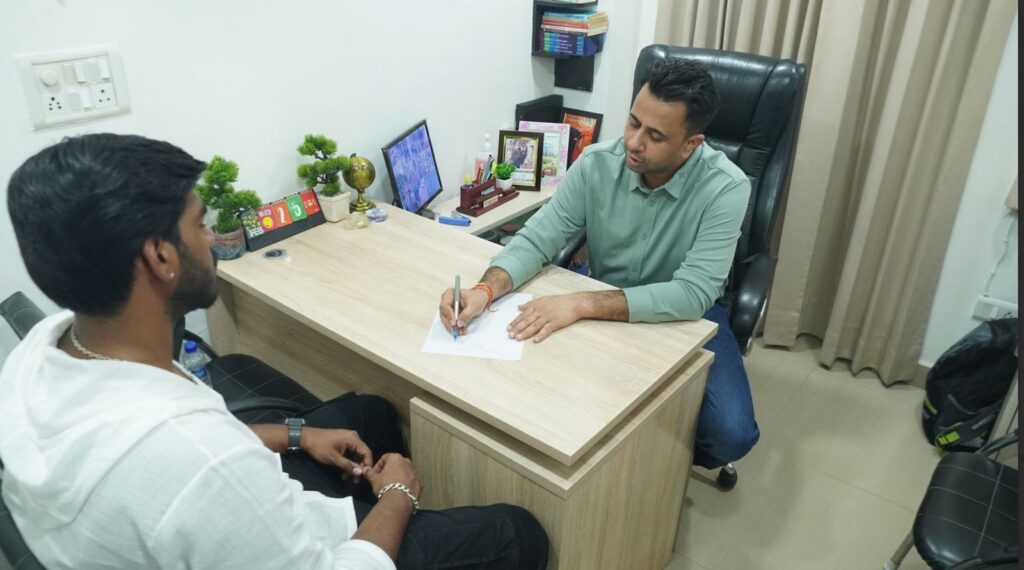
If your target is Canada or Australia — for university admission or PR — IELTS is almost always the right choice. If you are targeting US universities specifically, TOEFL may be worth considering. We advise on test selection during your initial counselling session at no cost.

Quick Answers

Frequently Asked Questions

How long does IELTS preparation take?

Typically 4–8 weeks with structured daily practice. Students with a strong English baseline (6.5+ informal speaking) often achieve their target in 4 weeks. Students starting below 6.0 generally need 8–10 weeks. Your diagnostic test at AptiGuide gives a more precise estimate based on your actual starting point.

Yes. IELTS has no retake limit. Scores from different attempts cannot be combined — each test produces an independent result. Most AptiGuide students see meaningful improvement in their second attempt when the root cause of the plateau has been identified and specifically addressed.

Yes — and we have documented outcomes to support this. Band 7.0 does not require native-level fluency. The band descriptors are explicit: Band 7 Writing acknowledges “some errors” in complex structures; Band 7 Speaking tolerates “some hesitation” and self-correction. Strategy and feedback, not perfect English, separate 6.5 from 7.0.

Self-preparation is viable for students already at 6.5+ who need marginal, well-targeted improvement. For students below 6.0, or stuck at a plateau despite regular practice, structured mentoring with rubric-mapped feedback produces measurably faster results. The key variable is not studying more — it is identifying and fixing the specific errors holding your score down.

Canada PR via Express Entry typically requires CLB equivalent to approximately IELTS 6.0–6.5, depending on the stream. Most mid-tier university programmes require 6.5. Top programmes in Engineering, Medicine, and Law often require 7.0–7.5. We map this precisely to your specific situation during counselling.

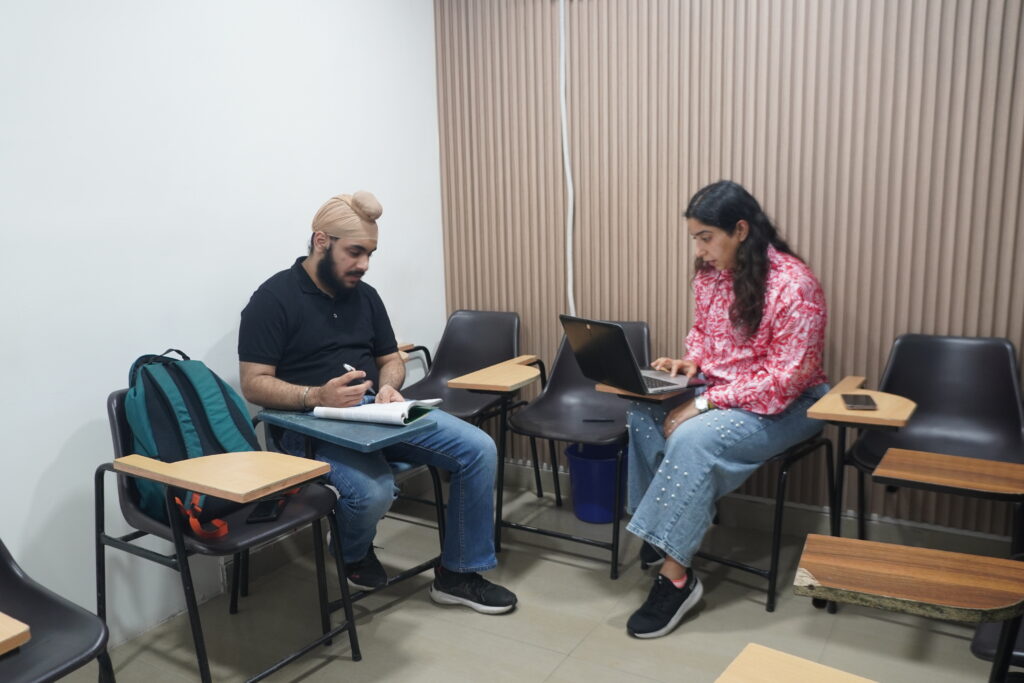
Both. Small-batch coaching includes personalised written feedback for each student. For working professionals or students with non-standard schedules, one-on-one mentoring sessions are available. Contact us to discuss the format that fits your timeline.

Institute in Jalandhar

We provide end-to-end career guidance, entrance test preparation, study abroad consulting, and profile building to help students make the right decisions and achieve long-term success.

Address & Contact

2nd Floor, Crystal Plaza, SCO-2, Market, near P.I.M.S Hospital, above ICICI Bank, Choti Baradari Part 1, Choti Baradari, Jalandhar, Punjab 144001

Call Us : 91 70097 33841
We are open from Monday to Saturday
10:00 AM - 07:00 PM

Copyright 2026 © All Right Reserved by AptiGuide