About Our CLAT Mentor
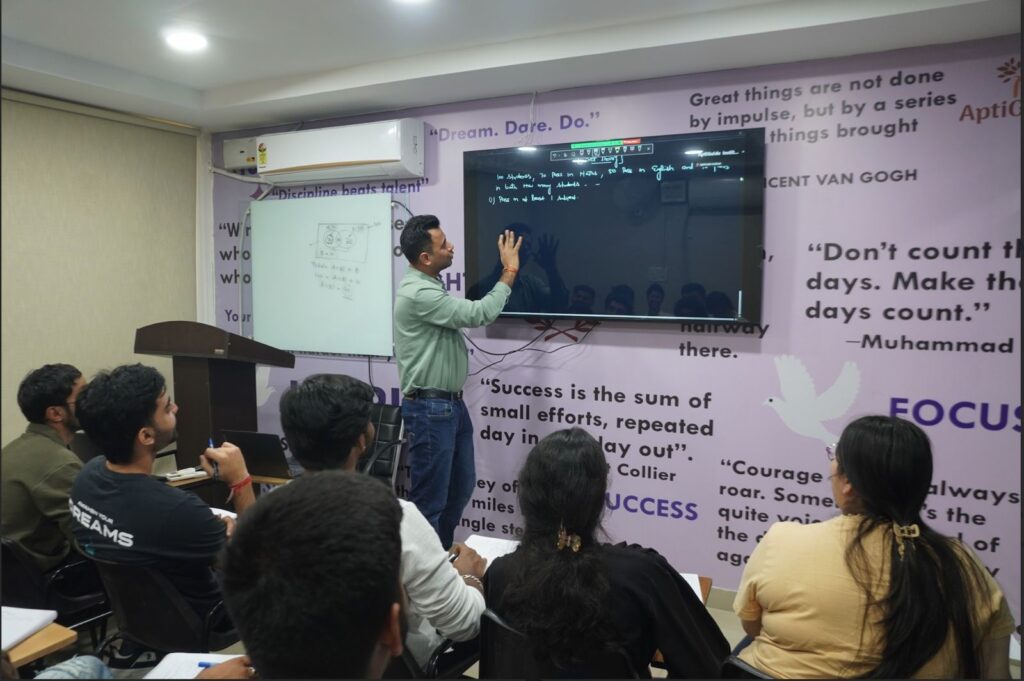
MENTOR Anshul Wadhwa — CLAT Mentor, AptiGuide Jalandhar
200 students mentored for CLAT
50+ NLU Admissions including NLSIU Bangalore, NLU Delhi, NLU Jodhpur, GNLU Gandhinagar, CNLU Patna and many more.
Contact: +91 70097 33841 | Office: Choti Baradari, Jalandhar
AptiGuide is based in Choti Baradari, Jalandhar and prepares students from Class 10 onward through in-person and hybrid sessions. We work with CLAT aspirants from Jalandhar, Ludhiana, Amritsar, Kapurthala, Hoshiarpur, Nawanshahr, and Pathankot.
The Common Law Admission Test changed fundamentally after 2020. It is no longer an exam of general knowledge, legal definitions, or vocabulary lists. Every section is now passage-based — students receive a 450-word passage and answer 4–5 questions based on what that passage says, not on prior knowledge.
A student who has memorised 500 legal terms and three years of current affairs but reads slowly will score lower than a student who reads efficiently, understands argument structure, and manages time across 120 questions in 120 minutes.
Most CLAT coaching in Jalandhar has not caught up with this shift. Institutes still run classes focused on GK notes, legal definitions, and vocabulary drills. Our preparation model is built around reading speed, passage comprehension, and section-wise time strategy — because that is what the current exam rewards.
Key Insight Every section requires reading a passage first. A student who reads slowly will run out of time regardless of their knowledge. The single highest-leverage skill in CLAT preparation is reading speed combined with comprehension accuracy — not GK revision or legal definitions. |
Section | Questions | Marks | Passage Type | What It Actually Tests |
English Language | 22–26 | 22–26 | 3–4 passages (~450 words each) | Reading comprehension, inference, tone, vocabulary in context — not standalone grammar |
Current Affairs & GK | 28–32 | 28–32 | Passages on recent events & static GK | Understanding and analysis of passages — not recall of bare facts |
Legal Reasoning | 28–32 | 28–32 | Legal principles in passage, applied to facts | Logical application of stated principles — no prior law knowledge needed |
Logical Reasoning | 22–26 | 22–26 | Arguments, analogies, assumptions in passage | Critical reasoning — conclusions, assumptions, logical flaws |
Quantitative Techniques | 10–14 | 10–14 | Passages with data, graphs, or numbers | Basic arithmetic applied to passage context — not standalone calculation |
TOTAL | ~120 | ~120 | 2 hours | Passage-based throughout; 0.25 negative marking per wrong answer |
English Language
Built entirely around reading comprehension passages from literary and journalistic sources. Questions test:
Preparation approach: Daily reading of quality English prose — The Hindu editorial, The Economist (selected articles), Indian Express opinion pieces. The goal is not to finish articles but to practice identifying main arguments in each paragraph within a time constraint.
Current Affairs and General Knowledge
Contrary to what most coaching institutes teach, CLAT GK is not a recall exercise. Passages are written about recent or historical events and students answer questions based on what the passage says — not what they already know.
What actually matters for GK preparation:
INSIGHT | A student who reads GK passages carefully can answer 70–80% of questions correctly even with limited prior knowledge of the event. Reading skill beats memorisation every time. |
Legal Reasoning
This section requires no prior knowledge of law. Each question set provides a legal principle — stated in the passage — and a fact situation. The student applies the stated principle to the given facts and selects the correct conclusion.
The skill is logical application, not legal knowledge. The most common mistake is trying to apply real-world legal knowledge instead of strictly following what the passage states.
Logical Reasoning
CLAT Logical Reasoning tests argument analysis — identifying conclusions, assumptions, logical flaws, and analogies within passage-based arguments. It does not test the puzzle-based or arrangement-based reasoning common in other aptitude exams.
Quantitative Techniques
The Quant section carries the fewest marks (~10%) and tests only basic arithmetic within a passage context. Students are not expected to solve complex problems.
STRATEGY | For most students, 2–3 weeks of focused Quant revision is sufficient. Spending excessive time on Quant at the expense of English or Legal Reasoning is a common and costly mistake. Target 8–10 correct out of 12 rather than attempting every question. |
CLAT scores are given as raw marks out of 120. Below is a realistic guide to which NLUs are accessible at which score ranges, based on recent admission data:
Score Range | Likely NLUs | Tier | Notes |
105–120 | NLSIU Bangalore, NALSAR Hyderabad | Tier 1 | NLU Delhi has AILET — a separate exam. NLSIU and NALSAR require 105+ for general category. |
98–105 | NLU Jodhpur, GNLU Gandhinagar, Hidayatullah NLU | Tier 1–2 | Strong career outcomes. Competitive but realistic for a well-prepared student. |
90–98 | NLU Lucknow, HNLU Raipur, RMLNLU Lucknow, NUALS Kochi | Tier 2 | Good placement records in corporate law. Realistic for most dedicated students. |
80–90 | Symbiosis Law School (SLAT), UPES, Amity | Private | CLAT score may not apply — some have separate exams. Good backup options. |
Below 80 | State law schools, other private colleges | State-level | Worth researching state-specific options alongside CLAT preparation. |
Law aspirants from Jalandhar often face a decision between multiple entry points. Here is how the options compare:
Exam | What It Opens | Reading Demand | Separate Prep? | Best For |
CLAT | 22 NLUs across India | Very High — passage-heavy throughout | Primary exam — build around this | Students targeting NLUs; broadest access |
AILET | Only NLU Delhi (top-ranked) | High — similar passage format | Moderate — CLAT covers ~80% | Students specifically targeting NLU Delhi |
SLAT | Symbiosis Law Schools (Pune, Noida, Hyderabad) | Moderate | Low — CLAT prep overlaps heavily | Students wanting Symbiosis as backup |
LSAT India | Private schools (Bennett, O.P. Jindal, etc.) | Moderate — logic-heavy | Low-moderate | Students targeting top private schools |
IIM 5-year IPM (management, not law) | Moderate | Significant — different exam type | Students uncertain between law and management |
Our preparation is built in four structured phases. We do not run the GK-heavy classroom model that most Jalandhar coaching institutes use. The current exam is passage-based throughout, and no amount of GK revision helps a student who reads slowly or selects questions poorly under time pressure.
Phase 1 — Reading Foundation (Months 1–3)
Before any CLAT content is introduced, we establish the student’s reading baseline. We assess reading speed (words per minute), comprehension accuracy on unseen passages, and time awareness. Most students from science and commerce backgrounds read at 180–220 wpm — insufficient for CLAT, which requires processing 450-word passages at 4–5 per section under time pressure.
Phase 2 — Section-wise Strategy (Months 3–6)
Each CLAT section has a different question structure and requires a different approach. We teach these separately before integrating them in mock conditions:
Phase 3 — Mock Tests and Error Analysis (Months 6–10)
Two full-length mocks per week, followed by a structured debrief session. The debrief is more important than the mock itself. We review: which passages were skipped unnecessarily, which question types show consistent errors, whether time allocation improved, and where wrong-option patterns are repeating.
Phase 4 — Full Simulation and Interview Preparation (Months 10–12)
The final phase moves preparation into exam conditions: mocks at 2 PM (the actual CLAT time), no breaks, no phones. Score stability across 4–5 consecutive mocks is the readiness signal.
Component | Details |
Duration | 10–12 months (for Class 11 or early Class 12 starters); 6-month crash program available |
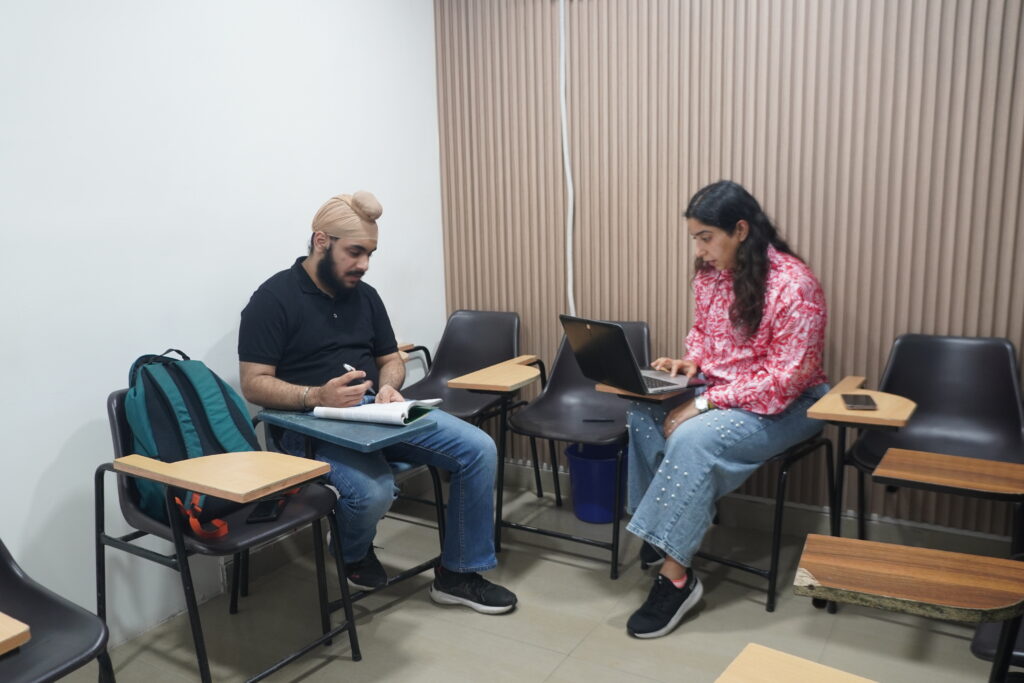
Session format | Small group sessions (max 8 students) + 1:1 debrief sessions |
Mode | In-person at Jalandhar office; hybrid available for students outside the city |
Study material | Curated reading packet (editorial sources), CLAT Official Practice Papers, sectional question banks |
Mock tests | 2 full-length mocks per week from Month 6 onward; 30+ mocks total |
Error tracking | Maintained session-to-session; reviewed in every debrief |
Exams covered | CLAT, AILET, SLAT — LSAT India on request |
Interview prep | Included for students who clear CLAT cutoff |
Case 1 — Humanities Student: Reading Speed Was the Barrier
Factor | Detail |
Background | Class 12 Humanities student from Jalandhar. Strong in History and Political Science. |
Starting score | 68/120 on first diagnostic mock — left ~25 questions unattempted. |
Problem found | Reading speed: 190 wpm. Strong GK knowledge but running out of time, not making errors. |
What we did | 3-month reading foundation before CLAT content. Daily 45-min editorial reading. Passage mapping technique from Week 2. |
Case 2 — Commerce Student: Legal Reasoning Confusion
Factor | Detail |
Background | Class 12 Commerce student. Comfortable with Quant and English. |
Starting accuracy | Legal Reasoning: 40% on initial diagnostic. Using real-world business law knowledge to override passage statements. |
Problem found | Classic error — applying prior knowledge instead of stated principle. Does not reduce with more content study. |
What we did | 4 weeks of application logic training. Rule: answer only from what the passage states. 20 practice questions daily with immediate debrief. |
Case 3 — Late Starter: 5 Months to CLAT
Factor | Detail |
Background | Class 12 student who approached us in August with CLAT in December — 5 months remaining. |
Starting situation | No structured preparation. Reading speed acceptable (240 wpm) but comprehension accuracy poor — rushing through passages. |
Strategy | Deprioritise GK, maximise English and Legal Reasoning accuracy. Compressed phase structure. |
What we did | 6-week reading and accuracy intensive, then straight to mock phase. Two mocks per week, same-day debrief. GK capped at 45 min/day. |
Not every student who is interested in law should prepare for CLAT, and not every student who is unsure about law should avoid it. Here is a realistic framework for making that decision:
Factor | CLAT is a Strong Fit | Reconsider Before Committing |
Reading preference | Genuinely enjoys reading — fiction, non-fiction, news | Dislikes reading or reads only when required |
Reasoning style | Comfortable with arguments, debates, analysis | Prefers definite answers, formulas, or structured problems |
Exam preference | Comfortable with open-ended interpretation questions | Prefers recall-based or calculation-based exams |
Career goal | Corporate law, litigation, judiciary, policy, international law | Engineering, medicine, or management with no law interest |
Timeline | Class 10 or 11 start — 18–24 months available | Class 12 second semester — less than 6 months available |
Backup clarity | Has identified backup options (SLAT, IPMAT, CUET) | No clarity on backup — treating CLAT as the only option |
The most common question we receive from parents in Jalandhar is whether law is a safe career. The honest answer is that it depends entirely on which institution the student attends and what they do during their five years there.
Factor | Top NLUs (NLSIU, NALSAR, NLU Delhi) | Mid NLUs (Tier 2) | Private Law Schools |
5-year total cost | ₹8–15 Lakhs | ₹8–12 Lakhs | ₹15–40 Lakhs |
Starting salary (corporate law) | ₹12–20 LPA | ₹6–12 LPA | ₹3–8 LPA |
Placement quality | Big Law, In-House MNCs | Mid-size firms, litigation | Variable by institution |
CLAT score needed | 105+ for Tier 1 | 90–105 | Separate exams usually apply |
ROI timeline | 3–5 years | 5–8 years | Variable — institution-dependent |
CLAT is the most competitive law entrance exam in India by volume — over 80,000 students appear for approximately 2,500 seats across 22 NLUs. The difficulty is not in the question content, which is moderate, but in the combination of reading demand, time pressure, and competition density. A student who reads well and manages their time effectively can clear competitive cutoffs with 10–12 months of structured preparation.
Class 10 is ideal for building the reading foundation — no CLAT content, just reading habits and comprehension. Class 11 is the right time to begin structured CLAT preparation — 18 months gives enough time for all four phases including extensive mock practice. Class 12 first semester is still workable with disciplined preparation. After boards in Class 12 with only 4–5 months left, success is possible but requires a compressed plan and realistic expectations.
No — and this is the most common misconception in CLAT preparation, particularly in Punjab where coaching culture tends to emphasise GK memorisation. The current CLAT format tests comprehension of GK passages, not recall of facts. A student who reads GK passages carefully can answer most questions correctly even without prior knowledge of the event.
Yes — stream does not determine CLAT performance. The exam tests reading, reasoning, and application of logic, none of which are stream-specific skills. Commerce students typically need extra work on Legal Reasoning logic. Science students often struggle with reading speed due to less exposure to analytical prose. Approximately 40% of NLU students each year come from non-humanities backgrounds.
A student who misses cutoff in the first attempt has several options: attempt CLAT again the following year (the exam is held annually), apply to private law schools with separate entrance exams (SLAT, LSAT India), or explore parallel paths such as integrated management programs (IPMAT). We plan for backup scenarios from the beginning of preparation — CLAT should never be a student’s only option.
Yes. AILET (All India Law Entrance Test) is the entrance exam specifically for NLU Delhi. It has a similar passage-based format to CLAT with some differences in difficulty and GK weightage. CLAT preparation covers approximately 80% of AILET preparation. We integrate AILET-specific practice from Month 8 onward for students targeting NLU Delhi.
Most students who clear competitive CLAT cutoffs have given 25–40 full-length mocks before the exam, with systematic debrief after each. The mock count matters less than the quality of analysis. Two mocks per week with same-day debrief are more valuable than four mocks per week with no review.
Fees is confirmed in the first session. No payment required before the initial consultation.
If you are considering CLAT — whether you are in Class 10, Class 11, or Class 12 — the right starting point is an honest assessment of where you currently stand, not a fee payment or a batch enrolment.
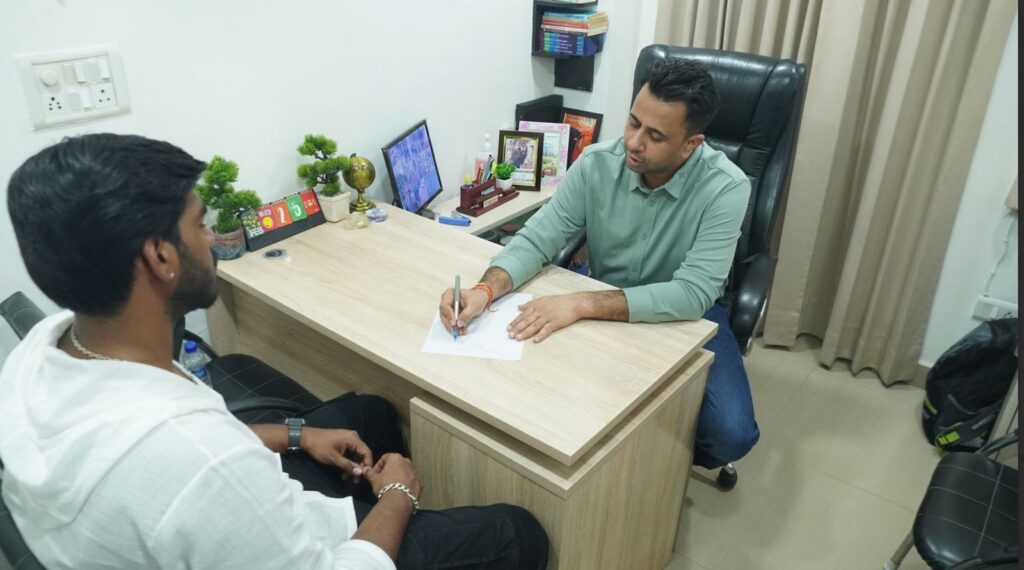
In the assessment session, we evaluate your reading speed, comprehension accuracy on an unseen passage, and logical reasoning baseline. We then give you a realistic picture of what preparation will take and whether the current timeline is sufficient for your target NLU. If the timeline is tight, we tell you that directly — along with what the realistic ceiling looks like and what backup options to plan for simultaneously.
We provide end-to-end career guidance, entrance test preparation, study abroad consulting, and profile building to help students make the right decisions and achieve long-term success.
2nd Floor, Crystal Plaza, SCO-2, Market, near P.I.M.S Hospital, above ICICI Bank, Choti Baradari Part 1, Choti Baradari, Jalandhar, Punjab 144001
Call Us : 91 70097 33841
We are open from Monday to Saturday
10:00 AM - 07:00 PM
Copyright 2026 © All Right Reserved by AptiGuide