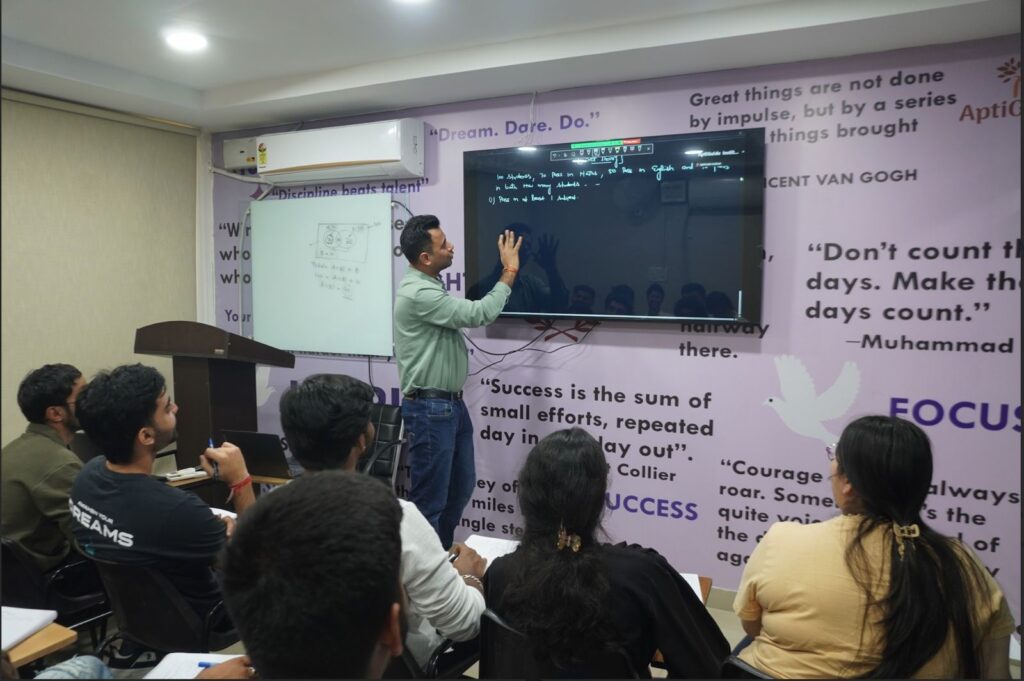
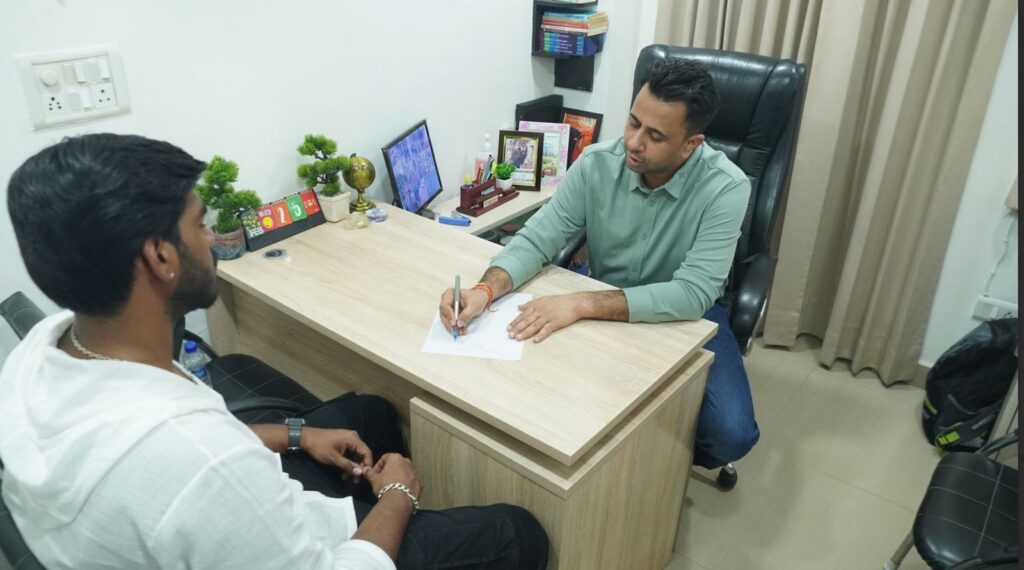
GMAT Coaching in Jalandhar

Score-Integrated MBA Admission Strategy — GMAT Focus Edition

GMAT Coaching That Goes Beyond the Score

Most GMAT aspirants do not fail because the exam is too difficult. They fail because they prepare for the wrong goal — chasing a 700 score without knowing which colleges they can actually get into, preparing for GMAT while ignoring the application, or delaying decisions until deadlines are missed.

A 700 on the GMAT does not guarantee an MBA admission. We have seen that repeatedly — students who put months into preparation, achieved a strong score, and then applied to the wrong universities or submitted a weak SOP and got rejected.

The reason is simple: most GMAT coaching focuses entirely on the exam and treats the application as someone else’s job. At AptiGuide, we treat the GMAT score as one variable in a larger admission equation — and we plan the entire equation from the start.

We are based in Jalandhar and work with working professionals, graduates, and CAT aspirants considering a shift to the GMAT path. Sessions are available in-person and online across India.


About Mrs. Priyanka — GMAT Mentor, AptiGuide

Priyanka holds a Gold Medal in MA English (Language & Linguistics) and has been mentoring IELTS candidates for over a decade, guiding students appearing at British Council and IDP test centres across Punjab. Her structured verbal system is built around IELTS band descriptors — not generic English improvement.

Available in-person at Jalandhar office and online for students across India.  Contact: +91 70097 33841

What is the GMAT Exam

The GMAT (Graduate Management Admission Test) is the globally recognised entrance exam for MBA programs at universities in the USA, Canada, Europe, Singapore, and select Indian programs including ISB and SP Jain.

Key characteristics that distinguish GMAT from other entrance exams:

  • Adaptive exam — adjusts difficulty based on your performance
  • Score-based system (205–805), not percentile-based like CAT
  • Multiple attempts allowed — up to 5 per year, 8 lifetime
  • Flexible section ordering — you choose the order you take each section
  • Year-round testing available at authorised centres or online


The GMAT Focus Edition — What Changed in 2023

The GMAT was restructured in 2023. The current version is called the GMAT Focus Edition and it is significantly different from the older format. Any coaching that does not acknowledge this change is working from outdated material.


Feature

GMAT Focus Edition (Current)

Old GMAT Format (Retired)

Total Duration

2 hours 15 minutes

3 hours 30 minutes

Number of Sections

3 sections

4 sections

Sections

Quantitative Reasoning, Verbal Reasoning, Data Insights

Quant, Verbal, IR, AWA

AWA (Essay)

Removed

30-minute essay included

Score Range

205–805 (in 10-point increments)

200–800

Section Order

Flexible — choose your order

Fixed order

Bookmark & Review

Can bookmark and edit answers within a section

Not available

Score Preview

See score before deciding to accept or cancel

Score shown after acceptance

Retake Policy

After 16 days; up to 5 times per year, 8 times lifetime

Same

Score Validity

5 years

5 years


Why This Matters for Preparation

The removal of AWA removes 30 minutes of prep time. The flexible section order changes warm-up strategy. The bookmark-and-review feature changes time management within sections. We build our preparation plan around the Focus Edition format — not the old one.

GMAT Focus Edition — Section-by-Section Breakdown

Section

Duration

Questions

What It Tests

Common Mistakes

Quantitative Reasoning

45 min

21 questions

Arithmetic, algebra, geometry, word problems — Problem Solving only (Data Sufficiency removed)

Over-calculating. GMAT Quant rewards estimation and pattern recognition, not brute-force arithmetic.

Verbal Reasoning

45 min

23 questions

Critical Reasoning and Reading Comprehension. Sentence Correction removed.

Applying CAT-style RC strategies. GMAT RC requires understanding argument structure, not just passage recall.

Data Insights

45 min

20 questions

Data Sufficiency, Multi-Source Reasoning, Table Analysis, Graphics Interpretation, Two-Part Analysis

Treating Data Sufficiency as a calculation exercise. The skill is determining whether data is sufficient.

What the GMAT Focus Edition Actually Tests — Topic-Level Detail

Quantitative Reasoning

The Quant section tests mathematical reasoning, not computation. Problems are drawn from:
• Arithmetic: Percentages, ratios, rates, number properties, prime factorisation, remainders
• Algebra: Linear and quadratic equations, inequalities, functions, exponents
• Geometry: Lines, angles, triangles, circles, coordinate geometry, area and volume
• Word Problems: Work-rate problems, mixture problems, profit-loss, simple and compound interest
• Statistics: Mean, median, mode, standard deviation, probability, combinations and permutations
Note: Data Sufficiency has moved to the Data Insights section in the Focus Edition. Quant now contains only Problem Solving questions.

Verbal Reasoning
Verbal tests your ability to evaluate arguments and interpret written material — not grammar or vocabulary.
• Critical Reasoning: Strengthen, Weaken, Assumption, Inference, Flaw, Evaluate, Bold-Face questions. Each is a short argument (2–5 sentences) followed by a question about its logical structure.
• Reading Comprehension: 3–4 passages (200–350 words each). Questions test main idea, inference, specific detail, application, and structure. Business, science, and social science topics are common.
Note: Sentence Correction was removed in the Focus Edition. Students who studied for the old GMAT need to shift their Verbal prep entirely to CR and RC.

Data Insights
This is the most distinctive GMAT section and the one most students underestimate. It contains five question types:
• Data Sufficiency: Two statements, one question. Determine if the data is sufficient to answer — five fixed answer choices. Logic-based, not calculation-heavy.
• Multi-Source Reasoning: 2–3 tabs of data (tables, text, charts). Questions require synthesising information across multiple sources.
• Table Analysis: A sortable data table with 3–6 statements to evaluate as True/False or Yes/No.
• Graphics Interpretation: A graph or chart with 2 fill-in-the-blank statements.
• Two-Part Analysis: A two-column question requiring two related answers — often involves trade-offs or systems of equations.

GMAT Score — What Range Gets You Where

GMAT Focus Edition scores range from 205 to 805. Here is a realistic picture of what scores open which doors — based on published school data and student outcomes we have seen:


Score Range

Where It Gets You

Realistic Target Schools (Examples)

What It Signals

655–705

Strong application to good global MBA programs

Purdue Krannert, UT Dallas, York Schulich, Rotman (with strong profile)

Competitive applicant at target schools

705–745

Competitive at top-25 global programs

ESADE, IE, Rotman, UNC Kenan-Flagler, Indiana Kelley

Strong applicant — profile and SOP become deciding factors

745–775

Competitive at top-15 programs

Emory Goizueta, Michigan Ross, Georgetown McDonough, ISB

Score is not the limiting factor — profile depth is

775+

Competitive at M7 and equivalent

Wharton, Booth, Kellogg, HBS, LBS, INSEAD

Score clears the bar — everything else must be exceptional

ISB (India)

Typically 700+ for strong consideration

ISB Hyderabad, ISB Mohali

Work experience and leadership profile weighted heavily

600–650

Mid-tier global programs

Regional US / Canadian programs, some European schools

Competitive with strong profile and clear career narrative


Counsellor Note

The most common mistake we see from Jalandhar students: targeting M7 schools with a 680 score and 2 years of experience, getting rejected everywhere, and losing an application cycle. Score targeting must be calibrated to the actual profile — academics, work experience, career goal, and SOP quality all factor in. We do this calibration before the application is built.

GMAT vs CAT vs GRE — Which Exam Should You Take?

This is one of the most common questions we get from students in Jalandhar, especially those who have already attempted or prepared for CAT. The decision is not GMAT vs CAT — it is India vs Global career path.

Factor

GMAT Focus

CAT

GRE

IPMAT

What it opens

Global MBA + ISB, SP Jain

IIMs, MDI, SPJIMR, FMS, XLRI

Masters programs (MS, MA) + some MBAs

Early management (Class 11–12)

Attempts

5 per year, 8 lifetime

Once per year

5 per year

Once per year

Score validity

5 years

1 admission cycle

5 years

Quant difficulty

Moderate — reasoning-heavy

High — calculation-heavy

Moderate

Moderate

Verbal difficulty

Moderate — logic and reading

High — vocabulary-heavy

High — vocabulary + writing

Moderate

Prep time

3–5 months typically

6–18 months for serious aspirants

2–4 months

3–6 months

Best for

Working professionals targeting global careers

Fresh graduates targeting India MBA

Students targeting specific Masters abroad

Early management aspirants

Common Mistake — CAT to GMAT Switch

A student spends 12 months on CAT preparation, does not clear the cutoff, switches to GMAT without changing their preparation style, and then wonders why their verbal score is low. CAT and GMAT test verbal reasoning in fundamentally different ways. The switch requires a fresh strategy, not a continuation.

Your Situation

GMAT is a Good Fit

Reconsider

Career goal

Global MBA, international career, career switch via MBA

India-only career — CAT route typically more efficient

Work experience

2+ years (most programs prefer this)

Fresh graduate with no experience — most MBA programs require 2+ years

Timeline

Planning 12–18 months ahead of target intake

Applying in less than 6 months — preparation will be rushed

Exam preference

Prefer multiple attempts, year-round flexibility

Prefer a single high-stakes exam with structured coaching (CAT suits this better)

Verbal strength

Comfortable with logic and reading-based questions

Very weak in English — verbal prep will be a significant challenge

Financial clarity

Family has clarity on study abroad budget and ROI

No clarity on whether abroad is financially viable — career counselling first

GMAT is Not Just an Exam — It’s a Full Journey

Most students think: “First I will get a GMAT score, then I will think about colleges.” This approach fails. GMAT is only one part of the system.


Step

What Happens

Where Students Fail

Step 1

GMAT Score

Over-preparing for exam, under-preparing for everything else

Step 2

Profile Evaluation

No clarity on profile strengths and gaps

Step 3

University Shortlisting

Targeting wrong schools for their score and profile

Step 4

SOP + LOR

Weak SOP with no clear post-MBA narrative

Step 5

Visa

No preparation for visa process and documentation

Why AptiGuide — Not Just GMAT Coaching

We do not run large-batch classroom coaching. The GMAT is an adaptive exam that responds to individual weak areas — a batch of 30 students receiving the same lecture is not the right format for it.

Our approach is built around one-to-one sessions, structured error tracking, and integration of GMAT preparation with the MBA application timeline from day one.


What Most Coaching Centers Do

What AptiGuide Does

Focus only on the exam

GMAT preparation integrated with application strategy

No application guidance

University shortlist built alongside GMAT prep

No profile evaluation

Profile gaps identified and addressed from session one

No university strategy

Score target set based on actual school requirements

Students score well but apply to wrong colleges

Students apply to the right schools with the right narrative

How AptiGuide Structures GMAT Preparation

Phase 1: Diagnostic and Target Setting (Weeks 1–2)

Before any content teaching begins, we establish a baseline. The student takes an official GMAT Focus Edition mock (GMAT Official Starter Kit, free from GMAC). We review the result section by section — not just the total score, but accuracy by question type, time per question, and error patterns.
From this diagnostic, we set a realistic target score based on two inputs: the student’s profile strength and their target school list.


Phase 2: Concept and Accuracy Building (Weeks 3–8)
This phase addresses weak areas identified in the diagnostic. Quant and Verbal are taught differently:
• Quant: Concept sessions on weak topic areas using GMAT Official Guide problems. Emphasis on recognising question types and applying efficient strategies rather than brute-force calculation.
• Verbal CR: Argument mapping — identifying conclusion, premise, and assumption in each stimulus. Question-type-specific approaches for Strengthen, Weaken, Assumption, and Inference.
• Verbal RC: Passage mapping technique. Identifying the primary purpose, structure, and author’s attitude before reading the questions. Time management across 4–5 question sets per passage.
• Data Insights: Data Sufficiency logic drilled separately from calculation. Multi-Source Reasoning and Two-Part Analysis practiced as integrated exercises.
Error log maintained throughout — every wrong answer analysed for root cause (concept gap, strategy error, or time pressure mistake).


Phase 3: Timed Practice and Integration (Weeks 9–12)
Individual sections are now practiced under timed conditions. Question sets are mixed — not grouped by topic — to simulate real exam conditions where question type alternates unpredictably.
Focus shifts from accuracy to accuracy under time pressure. Students who are accurate on untimed practice but slow on the real exam often underperform their preparation level. This phase closes that gap.


Phase 4: Full Mock Tests and Analysis (Weeks 13–16)
Full-length GMAT Focus Edition mocks taken under real exam conditions — same time of day, same environment, no interruptions. We use official GMAT mocks first (GMATPrep from GMAC) and then supplement with verified third-party mocks.
After every mock: a structured debrief session. Score is secondary to error pattern analysis. We look at: which question types are still causing errors, whether time management has improved, and whether the student is using the bookmarking and review features strategically.
Target: two mock scores at or above the target score before registering for the actual exam.

Program Structure


Component

Details

Duration

3–5 months depending on baseline score and target

Session format

1:1 sessions, 90 minutes each, 2–3 sessions per week

Mode

In-person at Jalandhar office or online via Zoom

Study material

GMAT Official Guide (current edition), GMATPrep mocks, curated question banks

Mock tests

4–6 full-length mocks across the preparation period (official mocks used first)

Error tracking

Maintained session-to-session — reviewed in every debrief

Application integration

University shortlist, SOP direction, and application timeline built alongside GMAT prep

Post-exam support

Score review, retake strategy if needed, application submission support

Real Student Scenarios

These cases are drawn from actual coaching engagements at AptiGuide. Scores and outcomes are real. Personal details have been anonymised.


Case 1: IT Professional, 2 Years Experience — CAT to GMAT Switch

Background: Software engineer, 2 years at an IT firm in Chandigarh. Had cleared CAT with 85 percentile but did not convert IIM calls. Decided to explore GMAT and global MBA.

Starting point: GMAT diagnostic mock: 580. Strong in Quant (Q83), very weak in Verbal (V55) — a direct result of CAT-style verbal preparation.

Key issue: Treating GMAT CR like CAT logical reasoning — applying elimination strategies that fail against GMAT’s argument-structure-based questions.

What we did: 4-week intensive on CR argument mapping. RC passage structure technique. DI Data Sufficiency logic (separate from calculation). Daily 90-minute sessions for 14 weeks.


Case 2: BCom Graduate, No Work Experience — Score-First Planning

Background: BCom from Jalandhar, just completed graduation. Wanted to do MBA abroad immediately. Had not taken any exam.

Key finding: Most reputable MBA programs require 2+ years of work experience. GMAT preparation at this stage makes sense but application strategy needed to account for this gap.

What we did: Advised a ‘score-now, apply-later’ path. Built a 4-month GMAT preparation plan. Simultaneously planned for 2 years of structured work experience in a relevant field.


Case 3: Working Professional, 5 Years Experience — Profile-Heavy Application

Background: 5 years in a family manufacturing business in Ludhiana. Strong operational experience but no formal corporate role. Targeting ISB and mid-tier US MBA programs.

Key finding: Profile was stronger than the student realised — entrepreneurial experience is valued at ISB and certain US programs. The GMAT score needed to be 700+ to make the application competitive.

What we did: 15-week preparation plan targeting 700+. Profile narrative built around business growth and operations leadership. SOP structured around entrepreneurial experience and the specific MBA outcome sought.

For Parents: Is GMAT and a Global MBA Worth the Investment?

This is the right question to ask, and we take it seriously in every parent session we run. The honest answer is: it depends on what the student does with the degree.

A global MBA from a reputable program — Rotman, ISB, ESADE, or a US top-25 school — opens doors to consulting, investment banking, and international corporate roles that are genuinely difficult to access otherwise. The salary premium is real, but it requires the student to actually build the profile, network, and career during the MBA, not just attend classes.

The risk is not the degree itself — it is the wrong school, the wrong program, or the wrong timing. We walk through the ROI calculation in the parent session: total cost, realistic first-year salary in the target country, loan repayment timeline, and what happens if the student returns to India.


Factor

Global MBA (Good Program)

IIM / Top India MBA

Total cost

₹40–80 Lakhs (varies by country)

₹20–35 Lakhs (IIM A/B/C)

GMAT/CAT prep time

3–5 months (GMAT)

12–18 months (CAT seriously)

Work exp required

2–5 years for most programs

Optional for fresh graduates

Post-study work option

Strong (Canada, UK, Germany)

India placement only

Career reach

International — if you work abroad post-MBA

Strong India-based corporate roles

ROI timeline

5–8 years to break even (abroad)

3–5 years (India salary)

Who Should Consider GMAT Coaching at AptiGuide

  • Working professionals (2–8 years experience) targeting an MBA in USA, Canada, UK, Europe, or Singapore
  • CAT aspirants who did not convert calls and are considering a global MBA instead
  • Students who want GMAT preparation integrated with MBA application strategy — not isolated exam coaching
  • Families in Jalandhar, Ludhiana, Amritsar, Hoshiarpur, Kapurthala, and Nawanshahr who want in-person sessions
  • Students across India who are comfortable with structured online sessions

Eligibility

There is no strict eligibility requirement to appear for the GMAT. It is open to any graduate or professional. However, most MBA programs that accept GMAT scores require 2+ years of work experience for admission. A fresh graduate can take the GMAT and hold the score (valid for 5 years) while building work experience.

Quick Answers

Frequently Asked Questions

Is GMAT easier than CAT?

They test different things, so ‘easier’ depends on your profile. CAT Quant is more calculation-intensive and has tighter time pressure. GMAT Quant is reasoning-heavy — problems are designed to reward pattern recognition, not speed. CAT Verbal is vocabulary and grammar-heavy. GMAT Verbal tests logical argument analysis and reading interpretation — most Indian students find this harder initially. Engineers from CAT backgrounds typically find GMAT Quant easier and Verbal harder. Commerce students find the reverse.

For most students starting from a 550–600 diagnostic, reaching a 680–720 target takes 14–18 weeks of structured daily preparation (90 minutes per day on weekdays). Students starting from a higher base or targeting a lower score improve faster. Students with very weak Verbal often need an additional 4–6 weeks focused on CR and RC foundations. We set a realistic timeline after the diagnostic session.

Under GMAT Focus Edition rules, you can retake after 16 calendar days. Maximum 5 attempts in any rolling 12-month period, and 8 attempts in a lifetime. Schools typically see all scores sent to them — most report evaluating the highest score, but some consider score trends. We factor retake strategy into the preparation plan from the beginning, not as a last resort.

Most admissions committees report that they take the highest score and do not penalise retakes. Some schools average scores — this varies by program and is worth checking for each school on your list. A progression from 640 to 700 to 720 tells a positive story. A pattern of 700, 690, 680 over three attempts would raise questions. We discuss this before you register for any attempt.

No — and this point matters enough that we address it in the first session. A 750 with a weak SOP and no clear career narrative gets rejected. A 690 with a strong profile, specific post-MBA goal, and well-written application gets shortlisted. GMAT opens the application to be read. Everything else determines whether you get in. This is why we integrate application strategy with GMAT preparation rather than treating them separately.

We cover both — and we believe that is the only way to do this properly. A student who prepares for GMAT in isolation, achieves a good score, and then starts researching schools has already wasted 6 months they could have used for profile building, research positioning, and SOP development. We build the application timeline from the first session and run GMAT preparation parallel to it.

Start With a GMAT Diagnostic Session

Planning to study abroad but unsure about your chances? This is for you if:

  • You are confused between CAT and GMAT
  • Your GMAT prep is not aligned with applications
  • You don’t know which universities you can actually target
  • You are unsure about ROI and career outcomes


In the diagnostic session, we assess your current level, discuss your target schools, review your profile, and give you an honest picture of what preparation will take and whether GMAT is the right exam for your goals. You get clarity, not confusion.

Institute in Jalandhar

We provide end-to-end career guidance, entrance test preparation, study abroad consulting, and profile building to help students make the right decisions and achieve long-term success.

Address & Contact

2nd Floor, Crystal Plaza, SCO-2, Market, near P.I.M.S Hospital, above ICICI Bank, Choti Baradari Part 1, Choti Baradari, Jalandhar, Punjab 144001

Call Us : 91 70097 33841
We are open from Monday to Saturday
10:00 AM - 07:00 PM

Copyright 2026 © All Right Reserved by AptiGuide