IPMAT Syllabus 2025 – The “Real” Section-Wise Breakdown (Indore, Rohtak & JIPMAT)
Here is the hard truth:
IIM Indore does not release a detailed official syllabus.
They only provide broad headlines like “Quantitative Ability” and “Verbal Ability.”
What you see on most education portals is a copy-paste of general aptitude topics.
After 16+ years of mentoring students and analyzing multiple years of actual IPMAT, Rohtak, and JIPMAT papers inside my classroom at AptiGuide, one thing is clear:
Studying everything equally is a trap.
This page is not a topic list.
It is a priority map of what actually gets asked — and what gives you maximum return on effort.
Official Syllabus vs. Real Exam Behavior
Officially, IPMAT includes:
- Quantitative Ability
- Verbal Ability
- Logical Reasoning (Rohtak/JIPMAT)
But real paper behavior shows:
- Arithmetic dominates workable scoring questions
- Indore’s short-answer punishes approximation
- Rohtak rewards speed over depth
- Verbal cutoffs are consistently competitive
Preparation must reflect reality — not just headlines.
The “Real” Quant Syllabus – Decoded by AptiGuide
Most students ask:
“Sir, do I need to study everything?”
No.
You need to study the high-return areas first.
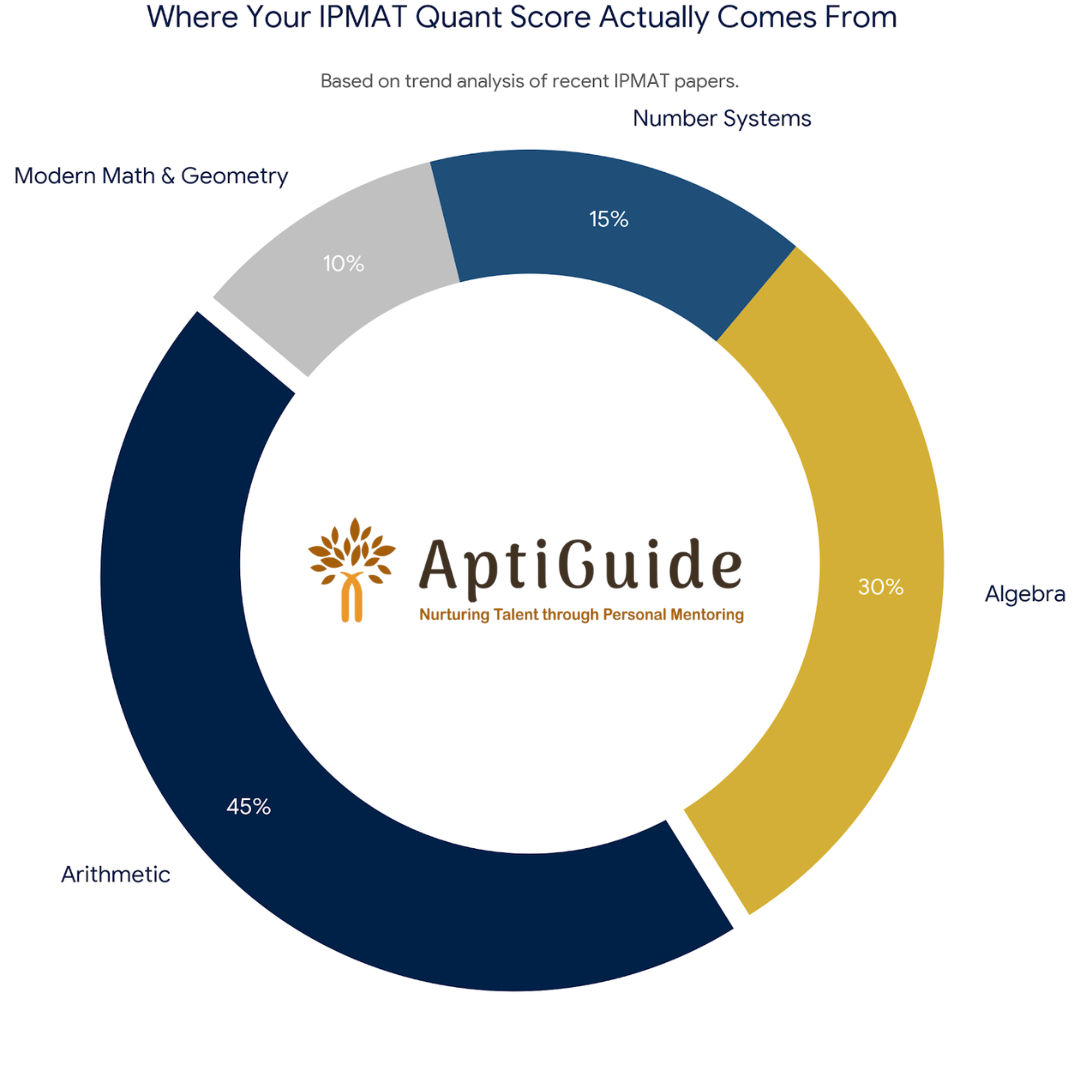
Priority 1 – Arithmetic (The Backbone of Your Score)
Weightage Reality: ~40–45% of workable questions
Official Topics:
- Percentages
- Profit & Loss
- Ratio & Proportion
- Time & Work
- Time, Speed & Distance
- Averages
- Mixtures
Mentor’s Insight:
Many students ignore Arithmetic to practice “advanced” topics like Permutation & Combination.
This is a fatal mistake.
In IPMAT Indore, Arithmetic consistently forms the largest pool of medium-difficulty, high-accuracy questions.
If you are weak in calculus, Arithmetic is your safety net.
In Rohtak, you should aim to solve core Arithmetic questions in under 45–60 seconds.
Accuracy + speed here stabilizes your entire paper.
Priority 2 – Algebra & Higher Math (The Indore Differentiator)
Topics:
- Linear & Quadratic Equations
- Inequalities
- Functions
- Logarithms
- Progressions
- Matrices & Determinants
Mentor’s Insight:
IIM Indore frequently combines Logarithms and Inequalities.
Students memorize formulas but struggle with logical framing.
Short-answer questions in this section require exact computation — no option elimination.
Commerce students often overestimate the difficulty here.
You do not need JEE-level depth.
You need functional clarity.
Priority 3 – Number Systems (The Concept Trap)
Topics:
- Divisibility
- Remainder Theorem basics
- HCF & LCM
- Unit Digit patterns
Mentor’s Insight:
Number Systems look like Class 8 math.
They are not.
Indore rarely asks “Find the remainder.”
Instead, they frame layered problems that combine:
- Remainder logic
- Pattern recognition
- Divisibility reasoning
Students who treat this casually lose unexpected marks.
Priority 4 – Modern Math (Rank Booster, Not Foundation)
Topics:
- Permutation & Combination
- Probability
- Set Theory
Mentor’s Insight:
Modern Math is often over-practiced.
Weightage fluctuates.
If you are short on time:
Focus on Probability fundamentals.
Avoid deep permutation complications unless fully comfortable.
The “Syllabus Traps” – What Students Misjudge
Trap 1 – Short Answer Approximation (Indore)
Approximation works in MCQs.
It fails in Short Answer.
Students who rely on elimination methods collapse in this section.
Train for precision early.
Trap 2 – Ignoring Sectional Cutoffs
IPMAT is sectional.
One weak section nullifies overall score.
Balanced preparation matters.
Trap 3 – Delaying Mocks
Students wait until syllabus completion before attempting mocks.
This delays exposure to real difficulty patterns.
Mocks reveal blind spots faster than revision.
Indore vs Rohtak vs JIPMAT – Strategy Matrix
Preparation must adapt to format.
Row Category | IIM Indore (IPMAT) | IIM Rohtak (IPMAT) | JIPMAT (IIM Jammu/Bodh Gaya) |
Nature of Game | Accuracy Game: High difficulty, “JEE-Light” math depth. | Speed Game: 120 questions in 120 minutes; sprint pace. | Balance Game: Even split across QA, DILR, and VA. |
Attempt Strategy | Selective Attempts: Prioritize core strengths; master the art of skipping. | Higher Attempts: Target 90–105+ questions to stay competitive. | Even Distribution: Mandatory prep across all three skill sets. |
Key Risk | Short Answer Precision: No options in SA section; 0 or 4 points only. | Time Management: Blistering pace (60s per Q) leads to fatigue. | Sectional Stability: Failing to maintain consistency across 3 sections. |
The Real Verbal Syllabus – Beyond Topic Lists
Officially, Verbal includes:
- Reading Comprehension
- Vocabulary
- Grammar
- Parajumbles
But real exam trends show:
- RC determines cutoff stability
- Vocabulary is contextual
- Trap options are increasing
Adaptive Mock Ecosystem
Students receive:
- 30+ full-length mocks
- 200+ sectional tests
- AI-powered adaptive test generator
- Automatic remedial testing
After every mock:
- Group discussion
- Individual review
- Weak area mapping
- Improvement plan
Mock analysis matters more than mock quantity.
Reading Comprehension (Cutoff Decider)
Passages often come from:
- Economics
- Social sciences
- Philosophy
- Current affairs
Mentor’s Insight:
Students read emotionally.
They choose answers that “sound correct.”
RC requires structured elimination.
That is why we use structured reading systems like our
RAMA Framework™ (link this internally to your RAMA explanation page).
Vocabulary
Memorizing 1000-word lists rarely works.
Context-based retention works better.
Grammar & Parajumbles
Scoring but trap-heavy.
Students lose marks due to careless interpretation, not lack of knowledge.
JIPMAT – Overlap & Difference
JIPMAT includes:
- Quant
- Data Interpretation
- Logical Reasoning
- Verbal
Differences:
- Entirely MCQ-based
- Slightly higher LR emphasis
- Conducted by NTA
Mentor’s Insight:
If you prepare seriously for IPMAT, you are largely prepared for JIPMAT.
Only exam temperament needs adjustment.
Where Your Score Actually Comes From
Based on trend analysis:
- Arithmetic → Core stability
- Algebra → Differentiator
- RC → Cutoff stabilizer
- Short Answer → Rank separator
Students who:
- Prioritize arithmetic
- Maintain verbal consistency
- Practice precision
outperform students chasing “difficult-looking” topics.
Final Advice Before You Open Your Next Book
Do not treat the syllabus as a checklist.
Treat it as a weighted map.
Prioritize.
Sequence properly.
Analyze mocks deeply.
If you want structured mentoring aligned with this priority system:
👉 Explore IPMAT Coaching in Jalandhar
July 26, 2023 Self-Paced
Lorem ipsum dolor sit amet, consectetur adipiscing elit. Ut elit tellus, luctus neceu ullamcorper mattis pulvinar.